Click here to join the FareShare Recipe Exchange Group

FareShare Recipe Exchange Group

Home | Chat | Recipes | Metrics | Cooking Temperatures | Members | Guest Book | Links

Scribe to our Free Recipe Gazette.

MUSSEL INFORMATION

Search our Recipe Archives.  Click Here!

Return to the FareShare Recipe  Master Index

From "Coast Living" Magazine

 Cooking and Food Information Index
 

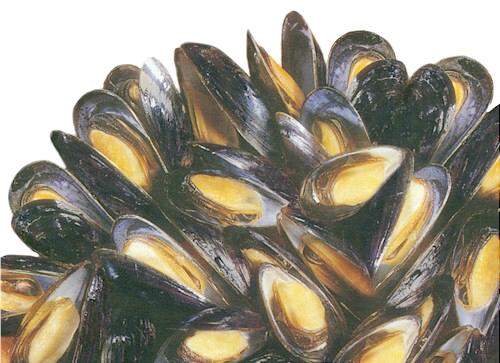
Mussels  Elongated, narrow shells distinguish mussels from other edible bivalves. Many varieties grow worldwide, but blue and green mussels most commonly appear in local markets. Identified by their inky, blue-black shells, blue mussels grow wild or are farmed in cold Atlantic and Pacific waters, while jade-color "greenshells" come from New Zealand. All varieties offer a good source of protein, calcium, magnesium, and selenium.
 

PURCHASE AND STORE:

  • Mussels are sold live, either loose or in bags packaged by growers.
     
  • Store mussels in the perforated bag they came in or in an open container covered only with damp paper towels. (Mussels will suffocate if covered in fresh water.) Stored properly in the refrigerator, they keep about one week.

PREPARE:

  • Before cooking, scrub mussel shells to remove the beard (fibrous threads) and any mud. Cultivated mussels are generally very clean and may not have any beard to remove.
     
  • Squeeze the shells of any mussel that feels particularly heavy, and try to slide the two halves back and forth. If you see mud oozing out, discard the mussel.
     
  • Mussels must be alive before cooking. After rinsing, their shells should be tightly closed. Do not prepare any that are open or have shells with holes or broken pieces.

COOK:

  • The simplest way to cook mussels is to steam them in white wine or broth and herbs. Bring about one inch of liquid to a boil, add the mussels, and then cover the pot tightly. In three to five minutes, the mussels will be done.  Finely chopped sweet onions and/or fresh garlic can be sautéed in butter in the pan first for added flavor.

ENJOY:

  • Remove the meat from the shells with a small fork. Or use an empty mussel shell as tongs to pluck the meat away from the rest.
     
  • Cooked mussel meat appears either orange-pink (females) or beige (males). There is no difference in flavor.
     
  • Serve mussels with their cooking broth -- and with bread for sopping the flavorful liquid at the bottom of the bowl.

FROM COSTAL LIVING MAGAZINE
TEXT BY JULIA DOWLING RUTLAND
FOOD STYLING BY GINGER SHERRILL


Top of Page

Cooking and Food Information Index

Disclaimer: The operators of the FareShare Website are not responsible for the content or practice of any website to which we link for your convenience.

Hallie du Preez and Art Guyer operate this project.

Provide feedback here.

Home | Chat | Recipes | Metrics | Cooking Temperatures | Members | Guest Book | Links

Scribe to our Free Recipe Gazette.Search our Recipe Archives.  Click Here!